covert communication · llm agents

Inference-time covert communication over LLM-agent conversations.

Feedback coding embeds hidden payloads in agentic dialogue at ≈0.2 bits/token and <0.3% message error — distortion-free, provably secure, and requiring no shared model or prompt.

Running example: two agents play a full game of chess through the covert channel beneath an ordinary chat.

Sidong Guo · [Author Two] · [Author Three] · [Author Four] · [Author Five] · [Author Six]
Georgia Tech Harvard SEAS ASU
scroll

the gap

Reliably and securely hiding high-rate messages in inference-time LLM text — model- and prompt-agnostic.

Our algorithm Burnashev Adaptive Posterior Matching (BAM) Steganography closes that gap on three fronts at once: reliability, security, and rate. The BAM algorithm is designed for conversational steganography, not watermarking application, but our algorithm outperforms current multi-bit watermark on the same setting by a wide margin.

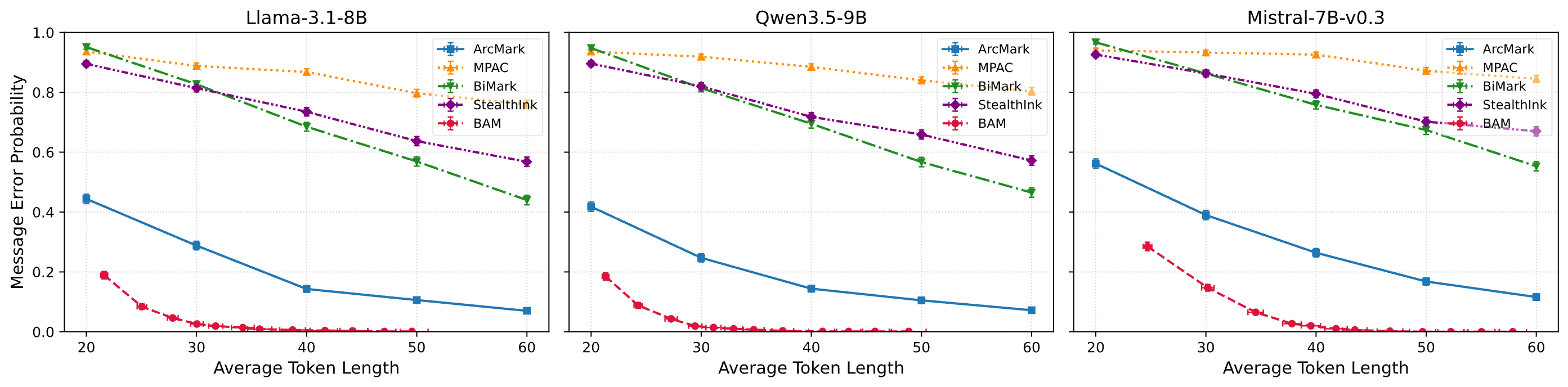
Message error probability vs average token length for BAM and five baselines across Llama-3.1-8B, Qwen3.5-9B-Base, and Mistral-7B.
Message error probability vs. average token length. BAM (red) against four inference-time black-box steganography baselines — ArcMark [1], MPAC [2], BiMark [3], StealthInk [4] — across three models. Lower is better; the x-axis is the average number of tokens used to carry an 8-bit message.

At a matched embedding budget, BAM drives message-error probability roughly an order of magnitude below every baseline, and it keeps falling toward zero as a few more tokens become available — while fixed-budget watermarking schemes plateau at high error on short, low-entropy conversational turns. The gain is consistent across Llama-3.1-8B, Qwen3.5-9B-Base, and Mistral-7B.

references

  1. ArcMark. ArcMark: Multi-bit LLM Watermark via Optimal Transport. Gilani, Atefeh and Long, Carol Xuan and Vithana, Sajani and Kosut, Oliver and Sankar, Lalitha and Calmon, Flavio P(baseline)
  2. MPAC. Advancing beyond identification: Multi-bit watermark for large language models.Yoo, KiYoon and Ahn, Wonhyuk and Kwak, Nojun (baseline)
  3. BiMark. Bimark: Unbiased multilayer watermarking for large language models. Feng, Xiaoyan and Zhang, He and Zhang, Yanjun and Zhang, Leo Yu and Pan, Shirui (baseline)
  4. StealthInk. Stealthink: A multi-bit and stealthy watermark for large language models. Jiang, Ya and Wu, Chuxiong and Boroujeny, Massieh Kordi and Mark, Brian and Zeng, Kai (baseline)

prior work vs. this work

From watermarks to a feedback channel.

Embedding signal in LLM output isn't new. Doing it on ordinary, variable-length conversation — where the receiver shares no model or prompt and reads only text — is where existing schemes fall short. As shown before, most inference-time schemes were designed as watermarks — a signal stamped onto generated text. Ours is designed as a channel: a variable-length feedback code that carries a message reliably over whatever the conversation happens to produce.

prior work

Either requires model/prompt access or too error prone

  • Designs vary — some assume a shared model and prompt, others read text alone
  • Mostly open-loop and fixed-budget — commit after a preset token count
  • Decoding error too high for low-entropy conversational turns
  • Preset budgets break when a turn ends early or runs long
this work — Burnashev Adaptive Posterior Matching Steganography

A feedback channel over the conversation

  • Model- and prompt-agnostic — the decoder only reads text
  • Side info from a shared seed, not a length-scaled key stream iOne 128-bit seed + a fresh per-session nonce, expanded on demand via HMAC-SHA-256.
  • Variable-length — adapts to however the turn unfolds
  • Reliable and secure even when each word carries almost no entropy

the setting

LLM inference channel is a channel with perfect feedback

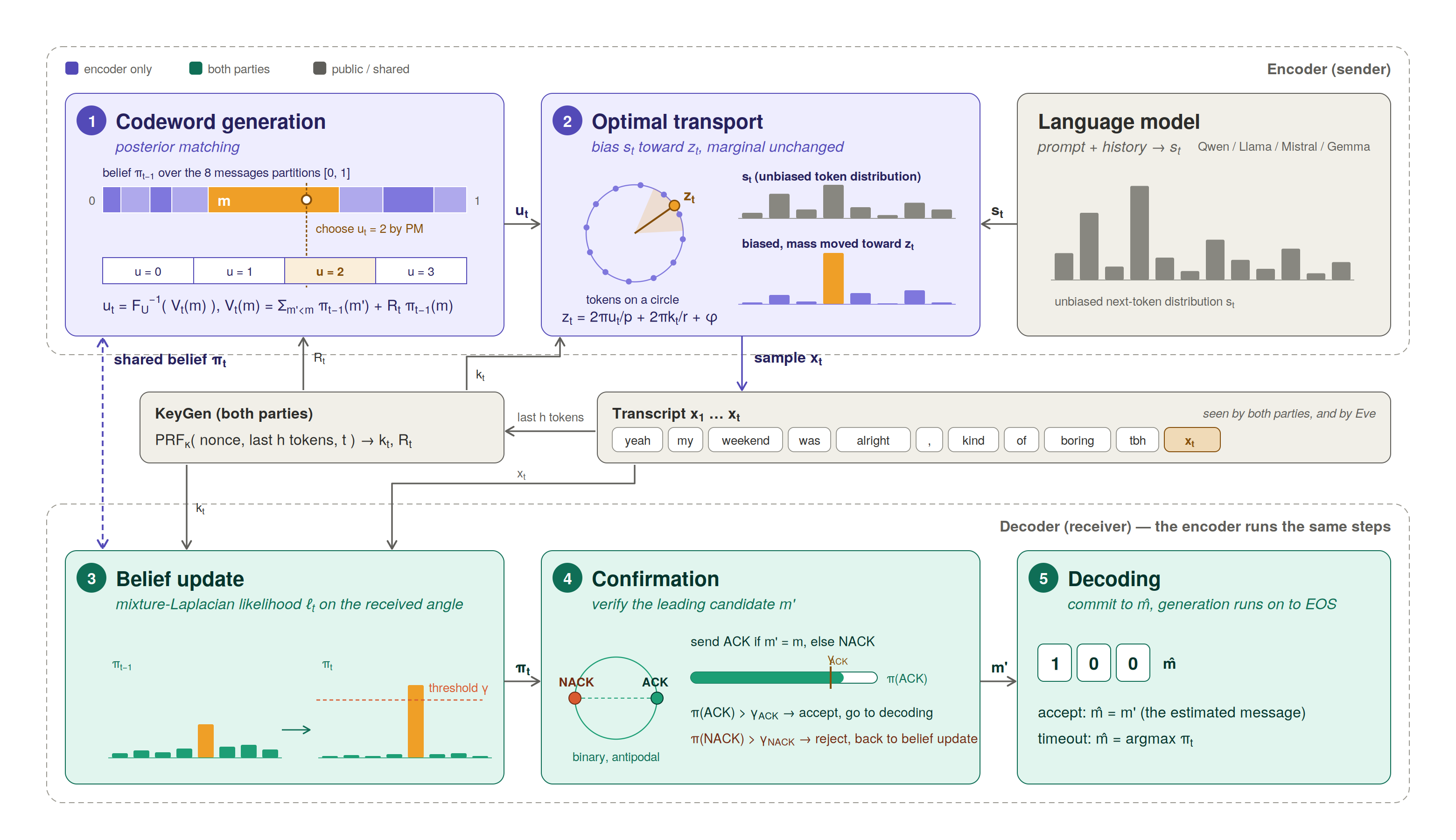
In the absence of editting, both parties see the same channel outputs. That makes the conversation a channel with perfect feedback — which is the source of embedding gain. The walkthrough below shows the whole scheme end to end; the full formalism is in the paper.

method — detail

Four obstacles, four fixes

No shared model or prompt, low-entropy text, LLM generation with unpredictable length, distortion-free and undetectablility. Here is each obstacle in the order the protocol resolves it — and the mechanism that does the work.

01
Challenge 01 — the decoder has no access to token distribution

Recover the symbol from text alone

The receiver has no token probabilities, no prompt, and no model in hand. It must read back the transmitted symbol using shared transcript and the seed

the fix — channel synthesis using OT coupling

Following ArcMarkiArcMark: tokens and symbols placed on a unit circle, sampling biased by angular distance., every token and every message symbol sits on a unit circle: the seed assigns each token an angle, and the target symbol defines a target angle. To transmit it, the encoder solves an optimal-transport couplingiConstrained coupling, solved via Sinkhorn: nudges toward the target angle while preserving the base marginal. that picks a token whose angle lands near the target while preserving the model's own word statistics. The receiver re-derives that angle from the token and seed — no model in the loop. That same statistics-preserving property is what buys security in Challenge 04.

02
Challenge 02 — LLM generation vary in length under distortion-freeness

Adapt to the LLM's variable-length generation

A real LLM generated conversational have arbitrary generation length (we don't assume any form of prompt tuning). A fixed codeword with a preset budget breaks both ways — it fails when the turn stops short and can't exploit one that keeps going.

the fix — variable-length coding via posterior matching

Instead of a codebook fixed in advance, the encoder builds online codebook: at each step it maps the message to the next symbol against the decoder's current belief, and both parties update that belief token by token. The belief is shared there's no preset budget — the protocol simply keeps generating while uncertain and stops the moment the belief is confident enough. That variable stopping time is the sequentiality gain.

03
Challenge 03 — chat can be low-entropy and prior methods are unreliable at high rate

Yamamoto-Itoh feedback code

Posterior matching localizes the message, but it does not improve the decoding error exponent by itself. The leading candidate can be confident and wrong. Embedding rate alone doesn't characterize a scheme: error exponent characterize the rate at which decoding error decays asymptotically.

the fix — a Yamamoto–Itoh decode-and-confirm phase

Once one candidate dominates, BAM stops localizing and starts verifying: it treats confirmation as a simple binary hypothesis test and re-transmits confirmation symbols before committing. This adaptivity gain is what classical feedback coding uses to push decoding error down at a given rates.

Where the reliability gain comes from
Feedback can't raise a channel's capacity, but it sharply improves how fast decoding error falls. Two effects combine: sequentiality (Challenge 02 — a variable stopping time, spend more tokens only while uncertain) and adaptivity (Challenge 03 — a dedicated confirmation phase, in the spirit of Yamamoto–Itoh). We measure the finite-length gains from stopping and confirmation directly rather than claiming an asymptotic optimum for the LLM channel. Full details are in the paper.
04
Challenge 04 — it has to stay undetectable

Guarantee security and the exact distribution

Every one of those biased tokens must leave no statistical trace — nothing a passive monitor could learn to catch, and nothing an adaptive API adversary could distinguish from ordinary generation.

the fix — exact word statistics + a keyed pseudorandom function

The coupling from Challenge 01 preserves the base model's next-token distribution exactly, so averaged over the secret key the observable text carries precisely the model's own word statistics — no distortion for a monitor to latch onto. A keyed, nonce based pseudorandom function, supplies the per-token side information, and a cryptographic reduction makes the whole transcript provably indistinguishable from ordinary generation for any polynomial-time adversary.

The upshot: no efficient test on the visible text does better than a coin flip. The full theorem and proof are in the paper.

does it work

Reliable — and undetectable

01

Far more reliable. Across three language models our algorithm offers about 98% drop in error rate at same embedding rate, compared to current baselines.

02

Provably secure. The transcript is computationally indistinguishable from ordinary generation for any polynomial-time adversary — the guarantee and its proof are in the paper.

03

Information-theoretically motivated. Our algorithm is inspired by information-theoretic optimal feedback coding schemes.

04

New security threat. Our strong embedding performance over conversational text without model or prompt sharing means that AI mediated text can now carry high information undetectably.

Full numbers, baselines, and ablations are in the paper.

what this means

Watching the words isn't enough

We build this to make a blind spot concrete: if coordinating agents want a channel hidden in plain conversation, transcript monitoring alone won't find it — the visible text is provably ordinary. Defenses have to look elsewhere: at the generation process, at the entropy available to agents, at the coordination itself rather than the payload. We regard that as the central open problem this work raises.

try it live

Watch two agents talk — and decode the secret

STEP 1

Play a chess game with AI

Make a chess move and enter a prompt to emit an AI mediated message.

STEP 2

Run the conversation

The agents chat naturally while the payload rides along underneath.

STEP 3

Reveal & decode

See the hidden message recovered from the text alone, turn by turn.

authors

Who made this

SG

Sidong Guo

Georgia Institute of Technology

Information theory, covert communication, machine learning security.

A2

[Author Two]

[affiliation]

[One line on research focus.]

A3

[Author Three]

[affiliation]

[One line on research focus.]

A4

[Author Four]

[affiliation]

[One line on research focus.]

A5

[Author Five]

[affiliation]

[One line on research focus.]

A6

[Author Six]

[affiliation]

[One line on research focus.]

get in touch

We'd love to hear from you